Gluten Free Reviewer Grocery

Showing posts with label FDA. Show all posts

Saturday, March 5, 2011

Weekend Edition Hot off the Press #12: What Qualifies as a Gluten Free Product?

When you pick up a package of gluten-free food, do you ever worry that the label might be deceiving? Could there still be some gluten lurking in there? The answer may be yes.

For many people that are gluten intolerant, gluten-free labels are a huge factor when deciding what they can and cannot eat. However, the Food and Drug Administration does not currently define the term “gluten-free”. Food manufacturers can use the label on food packages as long as it is “truthful and not misleading,” according to the FDA. Since the FDA does not regulate the labeling of gluten-free foods, it can be difficult to determine whether a food is truly gluten-free or not. In the past, there have been several incidents where grocery stores or food manufacturers have had to voluntarily remove products from shelves because the foods contained an excessive amount of gluten.

In 2007, the FDA proposed new regulation that would define the term “gluten-free” to be foods that contain less than 20 parts per million (ppm) of gluten from wheat, barley, or rye. As of right now, the regulation is still in draft form. If it passes in the future, food that is labeled “gluten-free” but contains more than 20 ppm of gluten would be “misbranded” and the manufacturer would suffer the penalties.

Outside of the U.S., there is an internationally recognized food code called the Codex Alimentarius, which is a set of food standards that cover food labeling, food safety, the use of pesticides, and food additives. It was developed and is continually updated by the Codex Alimentarius Commission, which was established by the World Health Orgainzation (WHO) and the Food and Agriculture Organization of the U.N. (FAO). According to the commission’s standards, food that is labeled gluten-free should contain less than 200 ppm of gluten. Unfortunately, the Codex Alimentarius is a voluntary set of standards that countries can choose to follow. It’s supposed to be used as a tool for countries to get in sync about food manufacturing protocols.

People who have celiac disease or gluten intolerance are certainly taking a slight risk when buying gluten-free foods. It’s not clear what specific amount of gluten is safe, but scientists continue to conduct studies on the subject. The proposed standard of 20 ppm by the FDA is considered safe, as is the 200 ppm threshold determined by the Codex Alimentarius Commission. At this time, our scientific technology isn’t precise enough to detect if a food has absolutely no gluten, but laboratories can detect levels that would affect people that are intolerant. Until any type of formal regulation is passed, consumers need to police products themselves. Stick with brands you know and listen to your symptoms.

Saturday, December 11, 2010

Weekend Edition Hot Off the Press #3: Where Did the Nutrition Facts Go?!


WHERE DID THE NUTRITION FACTS GO?!

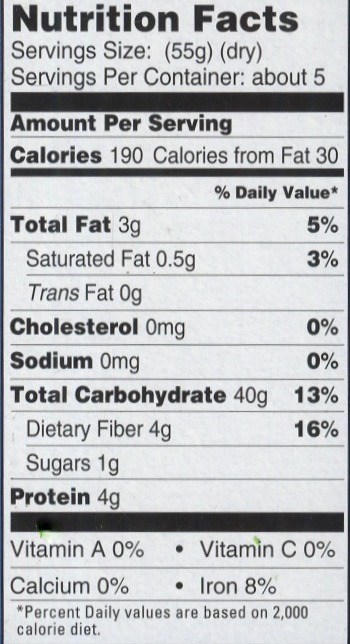
As we have been taste testing all this delicious gluten free food, we have been paying more attention to what is on the label.  The other day, we were having some gourmet tortilla chips and noticed that there were no nutrition facts on the package.  A few days later, we were having some brownies that were also missing the nutrition facts.  When we didn’t see those nutrition fact labels it brought up the question of when are nutrition facts required.  The nutrition facts label is our key to being informed about what we are eating.  In fact, we have become accustomed to it.  After digging around on the US FDA website, I was able to find the answer.  Hidden among the thousands of links on the website was the one word I was looking for…Exemptions. 

The one thing that caught my eye on the list is something called a Small Business Exemption.  I assume that formulating nutrition facts and getting them on a package is a costly process.  You have to pay a lab to analyze your product for the nutrition content and you have to do this for every single one of your products.  If it’s only for a couple of products, it’s probably not too bad, but if it’s for a whole line of products, the cost adds up.  Small businesses typically don’t have as much financial backing as larger companies and it would be difficult for them to finance all of these costs.  That’s where the Small business exemption comes in.  If your company has less than $50,000 in food sales you are exempt from putting nutrition facts on your products.  There is also an exception that says if you have more than $50,000 in food sales, and your total sales of food and non-food items is less than $500,000 you are also exempt. 

Other exemptions include food served or sold in restaurants, food served and sold for immediate consumption, and food processed and prepared primarily in a retail establishment and not outside of that establishment.  Restaurants, cafeterias, bakeries and deli’s fall into almost all of these categories.  Some of these places voluntarily provide this information to their customers, but most don’t.  This brings us to the question of… what is really in our food? 

There is a clause in the rules and regulation that states that if the company makes a claim about the product, like high in vitamin C or something similar, that product is no longer exempt and business must put nutrition facts on the packaging.

We all need to stay informed about what we are eating and the nutrition is a big part of that.  If the nutrition facts are missing, take that extra step to ask the necessary questions so that you are informed about what you are really eating.  You don’t want to dive into a dish blind, get informed.

*This information was found on the US FDA website.  Visit their website for more information about nutrition facts.